Despite the name, a flat roof isn’t actually flat. It’s a low-slope roof system with a slight pitch, designed to direct water toward drains rather than let it pool. You’ll find flat roofs on garages, home extensions, apartment buildings, and modern homes across the country.
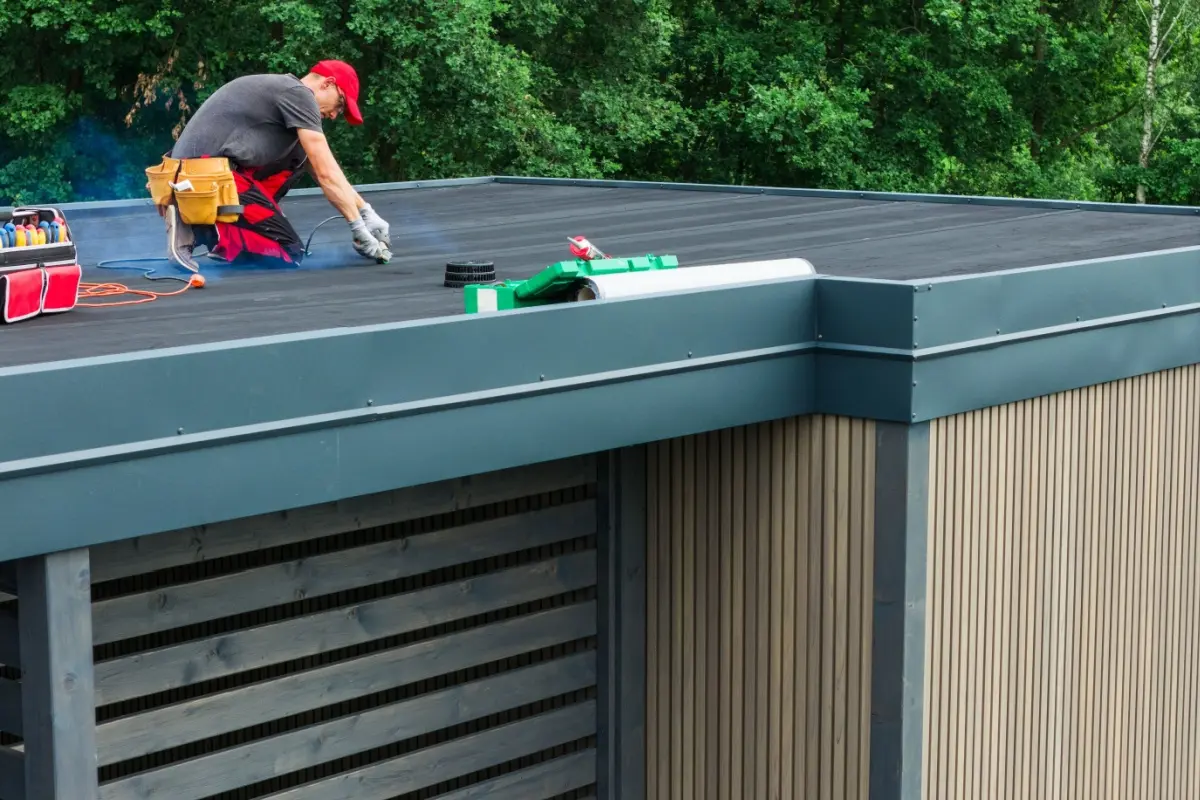
They’re practical, can sometimes cost less than pitched roofs depending on the system and design, and may be designed to serve as usable outdoor space.
This guide breaks down common flat roof systems, their costs, and how to keep them performing well.
Not all flat roofs are built the same way. As with other roof types, the system you choose affects how long the roof lasts, what it costs to install and maintain, how well it handles your local climate, and how easy it is to repair.
Layers are what make BUR work. Bitumen and reinforcing fabric get stacked on top of each other, then the whole thing gets finished with gravel or a protective coating.
It’s heavy, it’s tough, and it holds up well under foot traffic and years of sun exposure.
Older homes with larger roof areas tend to be the best fit. Installed, you’re looking at $3.50 to $7.50 per square foot.
Modified bitumen combines asphalt with rubber or plastic modifiers and comes in rolls that can be torch-applied or self-adhered.
It’s flexible enough to handle temperature swings without cracking, a useful trait in cold-winter climates, and strikes a decent balance between cost and durability.
Expect to pay around $4 to $7.50 per square foot installed, with a lifespan of 15 to 25 years.
EPDM is a synthetic rubber membrane and one of the most popular choices for residential flat roofs, particularly for garages and home extensions.
Standard EPDM is black, which absorbs heat rather than reflecting it. White-coated EPDM is available but costs more.
Material alone runs $3 to $6 per square foot. Installed, expect $5 to $13 per square foot, with a lifespan of 20 to 30 years.
TPO is a single-ply membrane with a reflective white surface and heat-welded seams that create a strong, consistent waterproof bond.
It’s a popular choice for homeowners who are really focused on energy efficiency in warmer climates. Installed cost runs approximately $4 to $12 per square foot, with a lifespan of 15 to 25 years.
PVC shares characteristics with TPO. It also has a reflective surface, heat-welded seams, and good energy performance. But it offers greater resistance to chemicals and grease, making it a practical choice near kitchen exhaust systems or HVAC equipment.
Installed cost runs roughly $5 to $14 per square foot, with a lifespan of 20 to 30 years.
SPF creates a seamless roof field and can be sprayed around penetrations, which reduces seam-related leak points when installed correctly. Penetrations still need proper detailing and maintenance.
It’s a strong fit for irregular roof shapes or roofs with many penetrations. Costs vary widely depending on thickness and coating type.
Flat roofs and pitched roofs do the same job (keeping water out) but get there in fundamentally different ways. If you’re comparing options like a gable, hip, or shed roof, this difference becomes especially important.
| Feature | Flat Roof (Low-Slope) | Pitched Roof |
| Drainage | Relies on a slight slope toward drains | Uses gravity and a steep angle |
| Structure | Simpler, more compact framing | More complex framing system |
| Maintenance | Requires regular inspection | Less frequent maintenance |
| Accessibility | Easier to access when safe and designed for access. | Limited access |
| Use of space | Can be usable (rooftop deck, solar) | Not typically usable |
Flat roofs work well in the right situations. They’re not the right choice for every home or every climate. Here’s an honest look at both sides.
| Advantages | Disadvantages |
| Modern appearanceFlat roofs suit contemporary and mid-century modern architecture and look intentional when designed well. | Drainage demands ongoing attentionDrains must stay clear, and low spots can lead to standing water that wears down the membrane. |
| Usable spaceThe surface can be used for a rooftop deck, solar panels, or even a green roof, especially useful in urban areas. | Higher leak risk at seams and penetrationsVents, pipes, and HVAC units create points where water can enter if not maintained. |
| Easier accessInspections and repairs are more straightforward. | Shorter lifespan for some systemsMost flat-roof materials last 15 to 30 years, which is shorter than some pitched-roof materials. |
| Lower profileHelps reduce building height, which can be useful in areas with zoning limits or tight spaces. | More frequent maintenanceRegular checks for debris, drainage, seams, and membrane condition are needed. |
| Potential energy savingsReflective materials like TPO and PVC can reduce heat gain when paired with proper insulation. | Installation quality matters morePoor installation can lead to early failure, making the contractor’s choice especially important. |
Here’s a side-by-side comparison of the main systems for residential use:
| System | Installed Cost (per sq ft) | Heat Reflectivity | Repairability | Lifespan |
| BUR | $3.50–$7.50 | Low to moderate | Moderate | 20 to 30 years |
| Modified Bitumen | $4–$7.50 | Moderate | Easy | 15 to 25 years |
| EPDM | $5–$13 | Low (black surface) | Easy | 20 to 30 years |
| TPO | $4–$12 | High | Moderate | 15 to 25 years |
| PVC | $5–$14 | High | Moderate | 20 to 30 years |
| SPF | $5–$10 | High | Moderate | 20+ years with recoating |
Flat roof costs vary based on material, roof size, local labor rates, roof complexity, and whether the existing roof needs to be removed.
Many homeowners explore roof financing options to spread out the cost of installation or replacement.
Inspecting your roof two to four times per year can help catch issues early. While some checks can be done visually, annual professional inspections are recommended.
The main things to stay on top of:
This is the question homeowners most often get wrong, usually in one of two directions: either patching a roof that genuinely needs replacing, or replacing a roof that only needed a targeted flat roof repair.
Repair is usually right when damage is isolated (small punctures, a lifting seam, or minor flashing issues), especially on a roof under 15 years old.
Replacement makes more sense when the problem keeps recurring, large membrane areas are failing, ponding water persists, the same spots keep needing repair, or the system is nearing the end of its expected lifespan.
The right system matches your climate, budget, and the length of your stay.
In hot, sunny climates, reflective membranes such as white TPO or PVC may help reduce heat gain, especially when paired with the right insulation. Actual savings depend on roof color, reflectivity, thermal emittance, insulation, home design, and local energy costs.
Modified bitumen is a practical mid-range option for shorter timelines. PVC or EPDM makes more sense for a 20-year stay.
The more HVAC units and vents you have, the more a seamless system like SPF is worth the extra cost.
Factor this honestly into your choice because some systems are more forgiving of deferred upkeep.
A flat roof is usually a low-slope roof. In many cases, that means the roof rises about 1 to 3 inches for every 12 inches of horizontal run. Even though it may look flat from the ground, the roof still needs enough slope to move water toward drains, scuppers, or gutters.
Flat roofs can work in rainy or snowy climates, but they need proper slope, drainage, flashing, insulation, and structural design for snow loads. If water remains for 48 hours or more after a storm, have a roofer evaluate the drainage.
It comes down to what’s on top and what’s underneath. Reflective membranes like TPO and PVC reduce heat gain in warm climates. Rigid foam insulation beneath the membrane improves performance year-round. A well-designed flat roof with the right materials can be genuinely energy efficient.