Refacing your cabinets can be significantly cheaper than replacing them, with a typical professional project costing about $5,000 to $15,000. How much cheaper? That depends on what you’d replace them with. Installed semi-custom replacement cabinets can run roughly $14,000 to $28,000, but basic stock cabinets may compete with refacing on price.
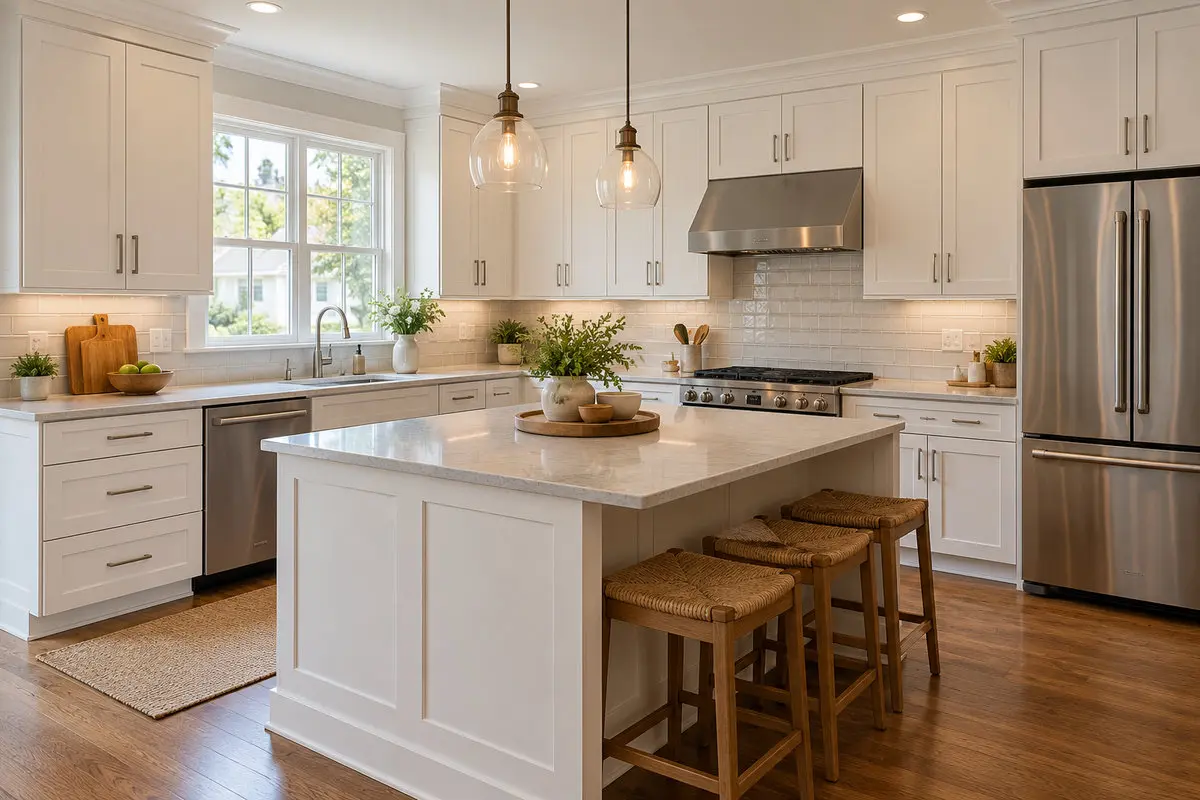
The best part is that you can change what people see without tearing out the cabinet boxes behind it.
It reminds me of watching one of those old western movies. It looks like the cowboys are walking through a real frontier town, but we all know that they only ever built the facade. What the camera sees is what matters, and that’s true in a kitchen, too, if the face of your cabinet is the only part that’s actually worn down.
Of course, the final costs depend on the cabinet size, material selection, labor, and other factors. We’ll cover all of that as we explore how much it costs to reface kitchen cabinets.
First, let’s look at what’s actually included in a refacing project. Then, we’ll break down the national cost figures. Here’s what’s generally worked on:
Our $5,000 to $15,000 planning range combines published estimates from national cost guides with a major retailer’s basic refacing package. It includes professional installation. Small, straightforward projects can fall below it, while large or premium projects can exceed $20,000.
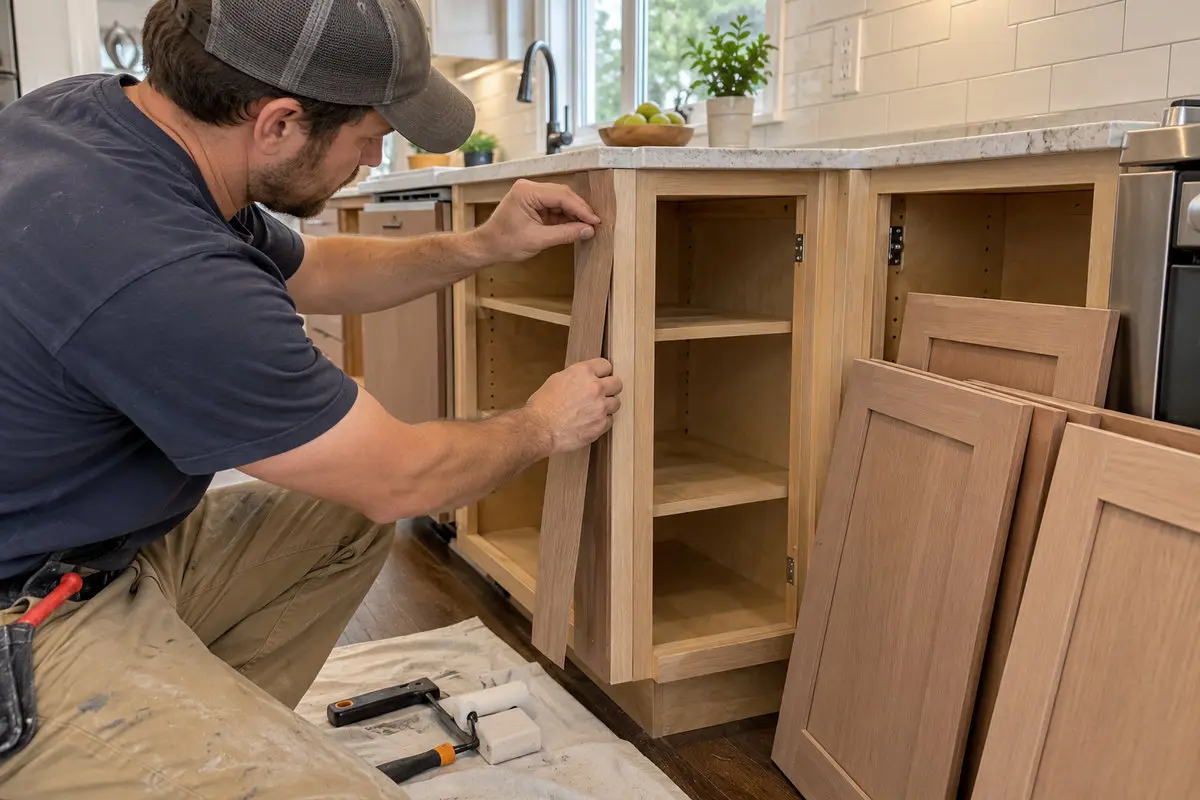
The boxes need to be worth keeping. Refacing won’t fix swollen particleboard, a failing cabinet structure, or a layout you dislike. Drawer boxes, organizers, cabinet interiors, repairs, and countertops may cost extra.
The table below compares illustrative budgets for small, medium, and large cabinet sets. Count doors and drawer fronts, not the kitchen’s floor space. A big room doesn’t necessarily have more cabinets.
| Project Example | Doors and Drawer Fronts Combined | Installed Planning Budget |
|---|---|---|
| Small cabinet set | 15 | $3,000–$7,000 |
| Medium cabinet set | 30 | $6,000–$13,500 |
| Large cabinet set | 45 | $9,000–$20,500 |
These examples use our calculator’s broad $200 to $450 allowance per front, rounded outward to the nearest $500. They are modeled budgets, not measured averages for kitchen sizes. Large end panels, tall doors, and premium finishes can push quotes higher.
So far, we’ve provided some general information to give you an idea of what you might pay. That’s how I always like to approach a purchase. Let me know the cost, and if it’s way outside my budget, I don’t want to waste time learning the specifics.
If you’re still reading, then you’re probably ready for more specifics. The following table shows how major factors can sway the price one way or the other.
| Factor | What Can Push the Price Up | What to Check |
|---|---|---|
| Number of cabinets | More doors and drawer fronts; tall pantry doors; exposed island panels | Count each front separately, including both doors on a double-door cabinet. |
| Cabinet box condition | Repairs, loose frames, moisture damage, and extensive preparation | Have the contractor inspect inside the boxes before quoting. |
| Door and front material | Wood species, intricate profiles, custom sizes, and finishes | Ask for the door’s construction and the box covering to be listed separately. |
| Hardware and finish | Premium pulls, soft-close upgrades, specialty colors, and molding | Check what the base price includes before adding upgrades. |
| Labor | Local rates, difficult access, detailed installation, and preparation | Compare the same written scope across bids. |
Chances are you’re going to go with one of the refacing materials in our table below. Your choice will affect durability, appearance, and cost. We’ll show you how they stack up.
| Material or Finish | Relative Cost | Appearance and Durability |
|---|---|---|
| Laminate | Usually lower | Many colors and wood looks; easy to clean. Quality laminates resist everyday wear, but damaged edges can be difficult to repair. |
| Thermofoil | Usually lower | Vinyl wrapped over a shaped core, often MDF, for a smooth finish. Excessive heat and steam can cause it to lift or peel. |
| Wood veneer | Usually middle to higher | A thin layer of real wood provides natural grain. Protect it from moisture; sanding too deep can cut through the veneer. |
| Solid wood doors | Usually higher | Natural grain and more scope for repairs or refinishing. Wood still moves with humidity and needs a protective finish. |
These categories overlap. Solid wood doors often go with veneered cabinet boxes, and some doors have solid wood frames with veneered centers. Ask to see samples. The actual product matters more than the label. Our guide to types of kitchen cabinets can help you choose.
Unfortunately, it’s hard to really pin down the labor cost ahead of time. More experienced builders may charge more, but your geographic location will also play a role.
Published guides commonly put labor at about 50% to 70% of the refacing price. On a $10,000 project, that’s about $5,000 to $7,000, already included in the total. Contractors may bundle the work rather than quote each step separately.
| Labor Stage | What You’re Paying For |
|---|---|
| Removal and preparation | Removing fronts and hardware, protecting nearby surfaces, cleaning, and preparing the boxes |
| Box facing | Measuring, cutting, bonding, and trimming the new exterior covering |
| Installation and adjustments | Hanging doors, attaching drawer fronts and hardware, aligning gaps, and cleaning up |
Those tasks explain the labor bill. There isn’t a reliable national price for each stage, so ask how your contractor accounts for them.
Use our kitchen cabinet refacing cost calculator below to get a rough estimate of how much your project might cost.
[Will insert Cabinet-Refacing-Calculator.html here.]
So far, we’ve focused on refacing. However, many homeowners save money by refinishing their cabinets instead.
The following table compares the options, explains what refinishing includes, lists typical costs, and outlines the pros and cons to consider.
| Option | Installed Planning Cost | What Changes and What Doesn’t |
|---|---|---|
| Refinishing | $2,000–$4,500 | Existing doors and boxes are prepared and refinished. Less expensive, but the door style stays. Extensive stripping or specialty finishes can cost more. |
| Refacing | $5,000–$15,000 | New doors and drawer fronts change the style; exterior box surfaces are covered or finished to match. Costs more, and the existing layout remains. |
These are whole-kitchen planning ranges, not prices for identical kitchens. If you like your doors and only dislike their color or worn finish, ask about refinishing or painting before paying to replace them.
Sometimes neither refinishing nor refacing is right for your kitchen. A contractor may come out and say it makes more sense to replace the cabinets. It helps to know how much that will cost.
Here’s how the costs and installation timelines compare.
| Option | Installed Planning Cost | Time on Site After Materials Arrive |
|---|---|---|
| Refacing | $5,000–$15,000 | Often 3–5 days; complex projects take longer |
| Semi-custom replacement | $14,000–$28,000 | Cabinet installation often takes about a week; related remodeling adds time. |
These replacement prices cover cabinetry and installation, not new counters, plumbing, electrical work, or layout changes. Removal and disposal may be separate. Ordering can add weeks to either option. Basic stock cabinets may compete with refacing, while fully custom cabinets can cost considerably more. See our cabinet installation cost guide for more on replacement.
As for return on investment, there isn’t a dependable national percentage for refacing alone. Reports about a minor kitchen remodel include other improvements. A better-looking kitchen may appeal to buyers, but that doesn’t mean you’ll get every dollar back.
Some homeowners refinish their cabinets. Others replace them. If you find yourself somewhere in the middle, then chances are the project will be “worth it.” That means you can often save money compared with a replacement, finish faster, and disrupt less, while still getting an improved-looking kitchen.
Keeping usable boxes also means less material to throw away. Just make sure you like how the kitchen works. If you’re collecting kitchen remodel ideas because you need more storage or a different layout, new fronts may not solve the problem.
Contractors are great, but they won’t always tell you how to save money on your project. Don’t wait until you’re at the kitchen table with the contractor to start thinking about how you’ll cut the costs. Here’s what you need to know:
If you’re considering kitchen remodel financing, compare the total repayment cost and the monthly payment. Home improvement financing can spread payments out, but interest and fees can make the project more expensive.
Let me tell you a nightmare scenario. You find a contractor ready to reface your cabinets. They come in and give you an estimate much lower than you were expecting. You’re excited and sign the contract. They start work immediately, but then the project pauses. Your kitchen is unusable, and weeks go by. You find that each phase only happens when the contractor can find subs outside their busy seasons. They could do it for less because they had a plan to cut costs. That plan ends up being a huge inconvenience to you.

Choosing a contractor is not just about finding the cheapest option. You want someone you can trust to do a good job on time and at a fair price. You can find someone like that, but it takes some work.
Start by looking at online reviews. Choose a few options, get the estimates, and then ask for references from recent refacing customers. Get the materials, included work, payment schedule, warranty, and expected start and finish dates in writing. Ask who will do the work and whether they’ll have all the doors ready before removal begins.
If you do your homework, you’ll have a much better chance of finding a reputable contractor. If you simply go with the cheapest bid, you may end up paying for it. Our guide to choosing a kitchen remodeling contractor covers more questions to ask.
If your kitchen cabinets need more than refinishing but less than replacement, refacing may be the answer. Now you know what the project may cost, and you’re ready to take the next step toward making your kitchen your own. Good luck!
Ready to talk through your project? Request a Pro, and Renovate will try to connect you with a local kitchen remodeling contractor.
Refacing is often cheaper than replacing cabinets of similar quality. But basic stock cabinets can compete with an expensive refacing package. Get both quotes if the numbers are close, and check whether removal, installation, hardware, and any countertop work are included.
Usually, no. Refinishing keeps your existing doors, so you’re mainly paying for prep and a new finish. Refacing adds new doors and drawer fronts. If you like the shape of your doors, ask whether refinishing would give you the change you want for less money.
Many straightforward refacing projects take three to five days on site once the materials arrive. Ordering custom doors and waiting for an available crew can add weeks. Ask for both the expected installation time and the order-to-completion schedule so you know what the quoted timeline means.
Often, yes, if the cabinet boxes are structurally sound and the surfaces can be properly prepared. The old doors can be replaced, and exposed box surfaces can receive a new covering. Address swollen cores, loose laminate, and water damage first. Have the contractor inspect them before you commit.
It may make your kitchen more appealing to buyers, especially if the current cabinets look worn or dated. That doesn’t guarantee a particular increase in value. Refacing alone doesn’t have a reliable national return percentage, and figures for an entire kitchen remodel shouldn’t be treated as cabinet-only returns.
There’s no set schedule. Think about refacing when the doors or finish no longer meet your needs,, but the cabinet boxes are still in good condition. Well-installed fronts can last for many years. Check the boxes’ condition before paying for another round of cosmetic work.
The new doors and drawer fronts can be just as durable as comparable parts on new cabinets. However, the boxes underneath are still the originals. Their condition, the quality of the covering and finish, and careful installation all matter. Refacing a weak box won’t make it strong again.
We reviewed U.S. cost guides, retailer packages, and installer pricing in October 2026. The $5,000 to $15,000 refacing range is a planning range informed by five published whole-project ranges, not a measured national average. We excluded painting-only prices, DIY materials, and packages that add new cabinets. Repeated figures from related or derivative sites were not counted as independent evidence.
The size examples use the calculator’s separate per-front model. We selected a broad $200 to $450 allowance based on published pricing, applied it equally to each door and drawer front, and rounded up to the nearest $500. This simplifies differences in door size, drawer size, and package inclusions. Material costs overlap too much to support four precise national averages. Local quotes may fall outside these estimates.
Refacing project costs: HomeAdvisor, HomeGuide, Modernize, Fixr, and The Home Depot.
Calculator pricing: Block Renovation, Fulton Revivals, and New Look Kitchen Refacing. Refinishing: HomeGuide, Angi, and Fixr. Labor share: HomeGuide and Fixr.
Semi-custom replacement comparison: Block Renovation and JMT Cabinets. Installation timing: Lowe’s and The Home Depot.
Materials: WalzCraft, Elias Woodwork, and Formica. ROI scope: JLC’s minor kitchen remodel description.